Enterprise AI
From Qwen3.8-27B to Flash-Next: why “Flash” does not mean a small model
Words such as “Flash”, “Next” and “6B active” can look like a simple speed-and-size ladder. They are not. Qwen3.8-27B and Qwen3.8-Flash-Next represent two different engineering bets in the same family: one runs a full dense model for every token, while the other activates only a relevant part of a much larger system.
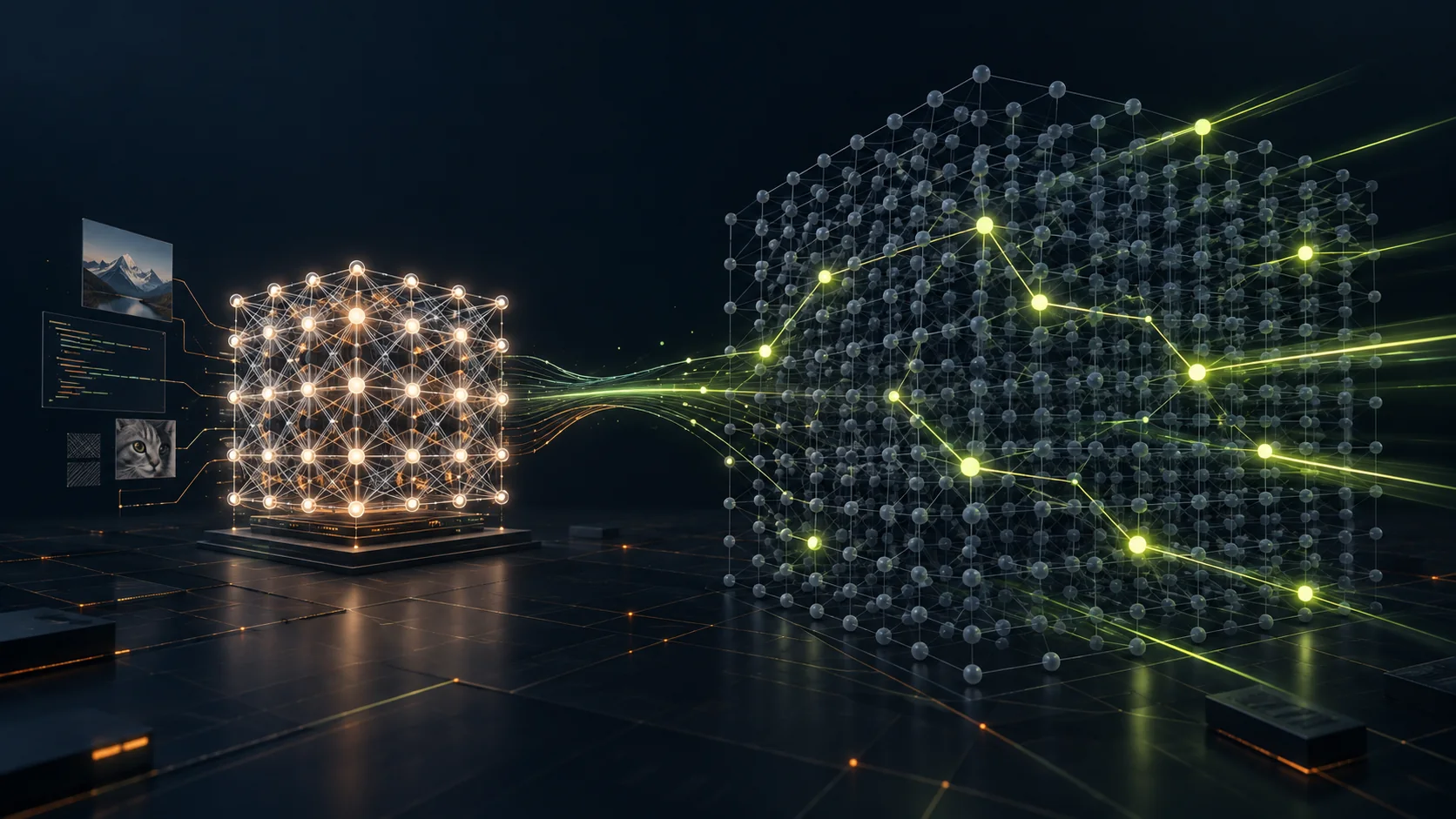
The Qwen3.8-27B calculation is more direct
Qwen3.8-27B is a 27-billion-parameter dense model. It understands images and video as well as text, and is published for coding, tool use and long-horizon agentic work. Thinking is enabled by default, but it can be disabled or bounded with reasoning effort.
For local use, the important part is that the weights are available under Apache 2.0. Transformers, vLLM, SGLang, Docker Model Runner and quantized variants can expose it through an OpenAI-compatible service. Local weights have a native 262,144-token context that can be extended to one million with the appropriate RoPE/YaRN setup. That does not make it effortless on every machine, but its source, licence and operating model are visible.
Flash-Next is not a 6B model
Flash-Next is a 125B-parameter mixture-of-experts model. Roughly 6B parameters activate for each token, alongside 51B of n-gram embeddings and 4B of MTP components. “6B active” therefore does not mean its files or memory needs resemble a 6B dense model.
Qwen presents it as an experimental preview of the Qwen4 architecture. Qwen Sparse Attention, gated residuals and n-gram embeddings aim to combine quality with less active computation. It can be served locally, but the total weight size demands a more ambitious hardware and serving setup than the 27B model. “Flash” describes an efficiency and latency goal, not a small footprint.
Flash-Next and the hosted Flash are not the same product
The experimental open-weight model is Qwen3.8-Flash-Next. The managed production service is qwen3.8-flash. The hosted model builds on the Flash-Next architecture and adds a one-million-token context, built-in tools and a managed API. Treating the two names as interchangeable hides meaningful licensing and operational differences.
There is also qwen3.8-omni-flash, a newer hosted service that accepts text, image, audio and video together while producing text. I could not verify an official open-weight repository for it. Anyone saying “the newest Flash” should therefore name the exact model.
Which one would I choose?
If control, data boundaries and predictable operation on my own infrastructure come first, the dense 27B model is easier to reason about. I would measure quantization, context and thinking settings against the real workload, and separately verify any third-party label such as “uncensored”, which is not an official Qwen model identity.
If a managed service, very long context and low latency matter more, the qwen3.8-flash API may be the practical choice. I see Flash-Next less as an automatic replacement for 27B and more as a way to understand the architectural direction toward Qwen4. Qwen’s benchmarks are a useful signal; my decision evidence is still my own prompts, tool calls, latency and total operating cost.
The short decision
Qwen3.8-27B is a locally deployable dense model under Apache 2.0. Qwen3.8-Flash-Next is a much larger experimental architecture that activates fewer parameters per token and uses the Qwen Community License 1.0. qwen3.8-flash is the managed production API built in the same direction.
There is no single best model here. The choice is which boundary—local control, hardware, context, licensing or latency—matters most to the product.